
Rethinking what we think we know about ignorance
If you think global ignorance is rising, you’re not alone. From AI-induced brain rot to politics and conspiracy theories, misinformation is widespread. In your personal life, you probably encounter ignorance all the time.
There are countless examples of how bad ignorance can be. But have you ever considered that ignorance might actually be good for you?
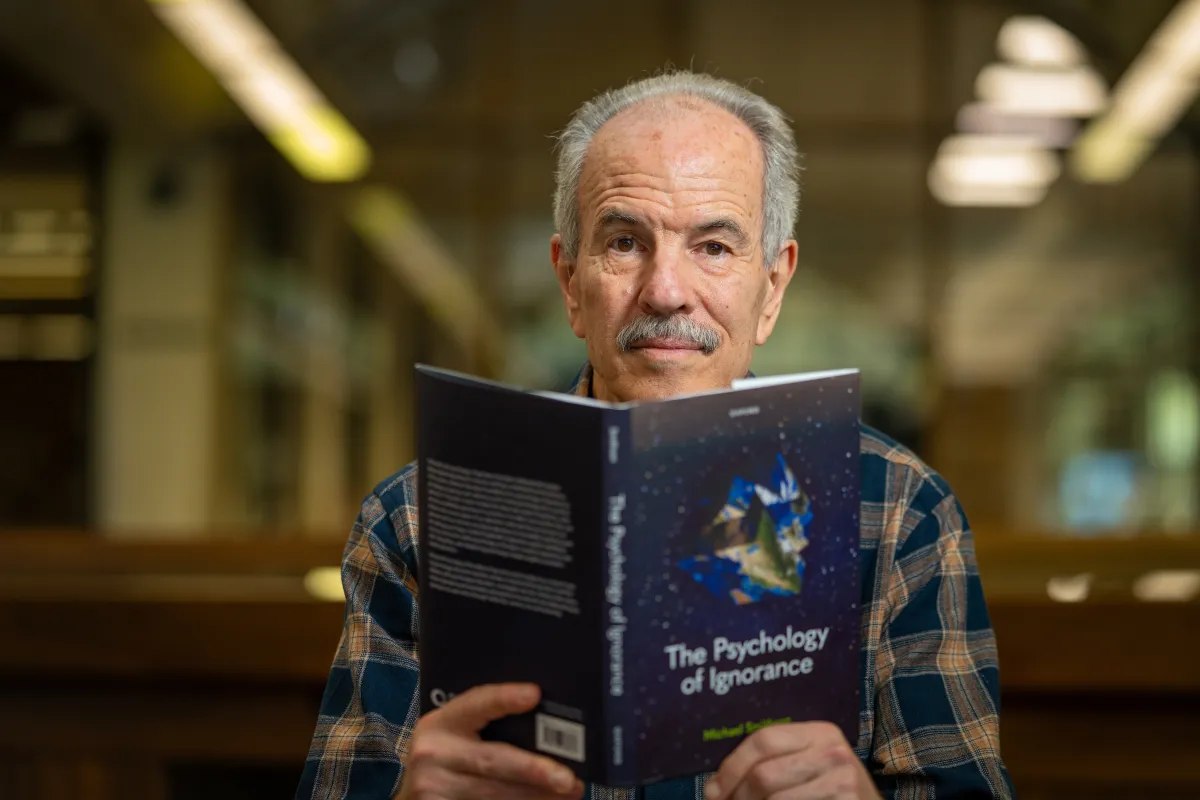
It’s a question that has occupied Professor Michael Smithson from The Australian National University (ANU) for much of his career. He’s an Emeritus Professor at the ANU School of Medicine and Psychology, and an expert on what we know about what we don’t know.
“There are a lot of things that we choose not to know about,” he explains.
“If you don’t have uncertainty, what choices can you make about your future? You have no freedom.”
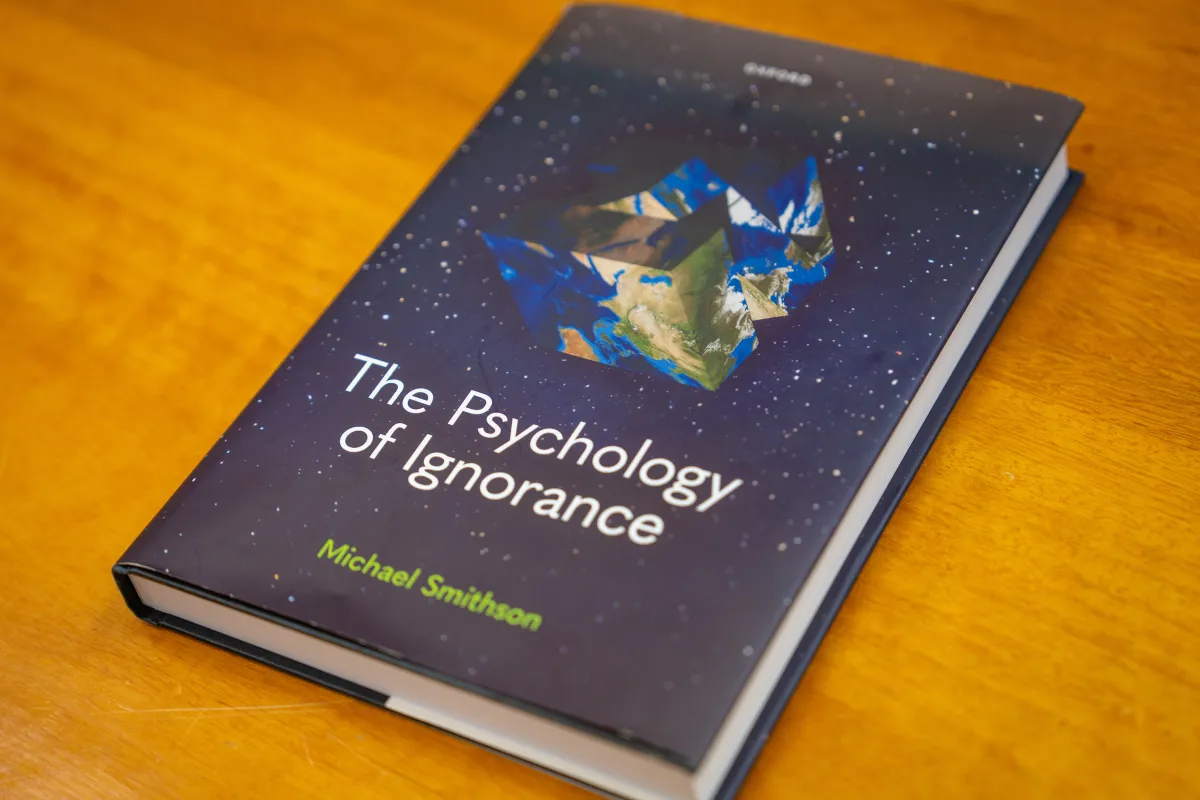
Professor Smithson’s latest book, The Psychology of Ignorance, explores how psychologists deal with unknowns and uncertainty.
He’s found that whilst psychology has mostly ignored ignorance, it is a common thread woven through neuroscience, cognitive, clinical, social, and organisational psychology. You just need to know how to look for it.
If you keep looking, you start to see ignorance hiding in plain sight everywhere, from diverse academic disciplines to daily life. And it’s not always a bad thing.
Encouraging us all to consider if ignorance could not only be bliss, but also an important part of what makes us who we are.
Why ignorance is in bad need of a good PR plan
One reason ignorance has such a bad rap is that it is often used as a negative critique of others.
“Other people are ignorant, other people are stupid, and so on," says Professor Smithson.
“When we attribute ignorance, we’re being demeaning. The problem is that we don’t have a non-pejorative set of terms to refer to unknowns.”
We are often unaware of our own ignorance. But if you look past the negative stereotype, ignorance simply means the absence of knowledge.
“A lot of studies indicate that we tend to be overconfident about what we know,” says Professor Smithson.
“But if we’re asked to explain what we know about something, or how we know it, we quickly run into the realisation of ‘I thought I understood this, but I really don’t understand it at all’.”
For example, many of us think we know that the Earth is not flat, but can we explain how we know this?
Professor Smithson can spot when people are discussing ignorance, even though they use different language. In social contexts, this could be misinformation, lying, deception and stupidity.
In psychology, it can include concepts like uncertainty, blindness, fear of the unknown, and even the unconscious.
“Much of what psychology has to say about ignorance is not labelled that way.”
A worthy argument, decades in the making
As an expert on the psychology of ignorance, Professor Smithson’s background may come as a surprise.
“I’m not a psychologist,” he says. “My undergraduate degree was in mathematics, and then I did my PhD in sociology.”
Throughout his career, Professor Smithson has been interested in how we deal with unknowns.
Mathematics may have a reputation for offering absolute certainty, but he says when researchers tried to ground mathematics in logic in the early 20th century, they found that they couldn’t rule out the impact of paradoxes.
“All of a sudden, unknowns were in the citadel of certainty. After I learnt about this, I became fascinated with the concept that no matter where you go, there are unknowns waiting for us.”
Knowledge gaps are a key driver in academic enquiry. Without ignorance, what can we discover? And when we gain new knowledge, this often uncovers more unanswered questions waiting to be explored.
As Professor Smithson embarked on a PhD in the 1970s, sociologists were occupied with the theory that knowledge is socially constructed.
“If we accept that knowledge can be socially constructed, doesn’t this mean that unknowns are also socially constructed?”
The only problem: ignorance studies did not exist yet.
After completing his PhD, Professor Smithson started researching how ignorance is socially constructed and even wrote a book on the subject.
“But my work just sat there,” he says. “There were no citations, and no indications that anybody was reading it.”
He then pivoted to improving statistical methods for the social sciences. This led him to a new role as a quantitative methodologist in the psychology department at ANU.
“Giving me an opportunity to learn about psychology, almost like how an anthropologist would.”
Finally, in the early 2000s, his research on the sociology of ignorance started getting picked up in diverse disciplines, including biology and environmental science. Gradually, interest was building.
“But the more I learnt about psychology, the more I began to realise that here is a discipline that, for the most part, has not embarked on ignorance studies.”
The good, the bad and the ugly of the psychology of ignorance
Professor Smithson says that when ignorance is discussed in psychology, it is often about how an inability to deal with uncertainty can underpin many psychological disorders, including anxiety disorders and some types of depression.
“There certainly are dysfunctional kinds of ignorance that cause us anxiety and distress,” he says.
“For a person with obsessive-compulsive disorder, this could mean thinking, ‘Did I lock the front door?’, and then ‘Did I really lock it?’. They are fearing what they don’t know.
“It’s understandable that clinicians focus on dysfunctional anxiety and uncertainty.
“What about hope? What about pleasant surprises? What about excitement and thrill?
“We can feel curious. That’s an emotion unlike fear or anxiety.
“There’s a whole raft of positive emotions that require unknowns, and psychology has no theory about them.”
In writing the book, Professor Smithson found that the assumption that information is always good and uncertainty is problematic is widespread.
“Common sense will tell you that information is not always good. Some types of information can ruin your life.
“Psychology has a lot to say about uncertainty, but nothing to say about positive unknowns.”
Then there is the unconscious.
“I had to write about the unconscious because the claim that we have an unconscious, is easily psychology’s most spectacular claim about ignorance.
“Stating that we don’t know our own minds is pretty stunning.”
Over time, psychologists have moved away from some of the more controversial ideas about the unconscious being a hidden place for repressed memories and desires.
It’s now understood to be an important system for mental processes outside our awareness, that influences things like emotions, decision-making, judgements and behaviours.
“The greater the role that you give to the unconscious, the less of a role you give to conscious control. Understandably, people don’t like that.”
Professor Smithson’s message is that psychology needs to form a social constructivist view of ignorance.
“I hope that psychologists read this book. Especially students, as it contains many PhD topics waiting to be explored.”
Why we all need ignorance
Throughout history, people have always dealt with unknowns. But understanding ignorance, how it impacts us, the lives of others, and the world around us, is important in the current age.
“There is a huge amount of information available to us compared to 20 years ago, let alone a century ago,” says Professor Smithson.
“Along with that comes the burden that, with so much more to know, there is much more for us to be potentially ignorant of.
“I think many people in Western societies feel increasingly lost in a sea of information. We don’t have the time, or the brain power to pay attention to all of it, so how do we choose?”
It’s impossible for us to know everything. Instead, Professor Smithson argues we need to think more carefully about what we don't know, what we choose not to know, and how this shapes our lives.
If we do, we might discover that ignorance deserves more attention than it has received.
Because without ignorance, what is left to explore?
Join Professor Smithson and the ANU School of Medicine and Psychology for the launch of The Psychology of Ignorance:
- Thursday 25 Jun, 4 - 6pm
- Innovations Lecture Theatre, Anthony Low Building
- Registrations via humantix
The Psychology of Ignorance lays the foundations for a psychology of ignorance by providing an explicit and critical account of what psychology has said about ignorance. It is published via Oxford University Press.